
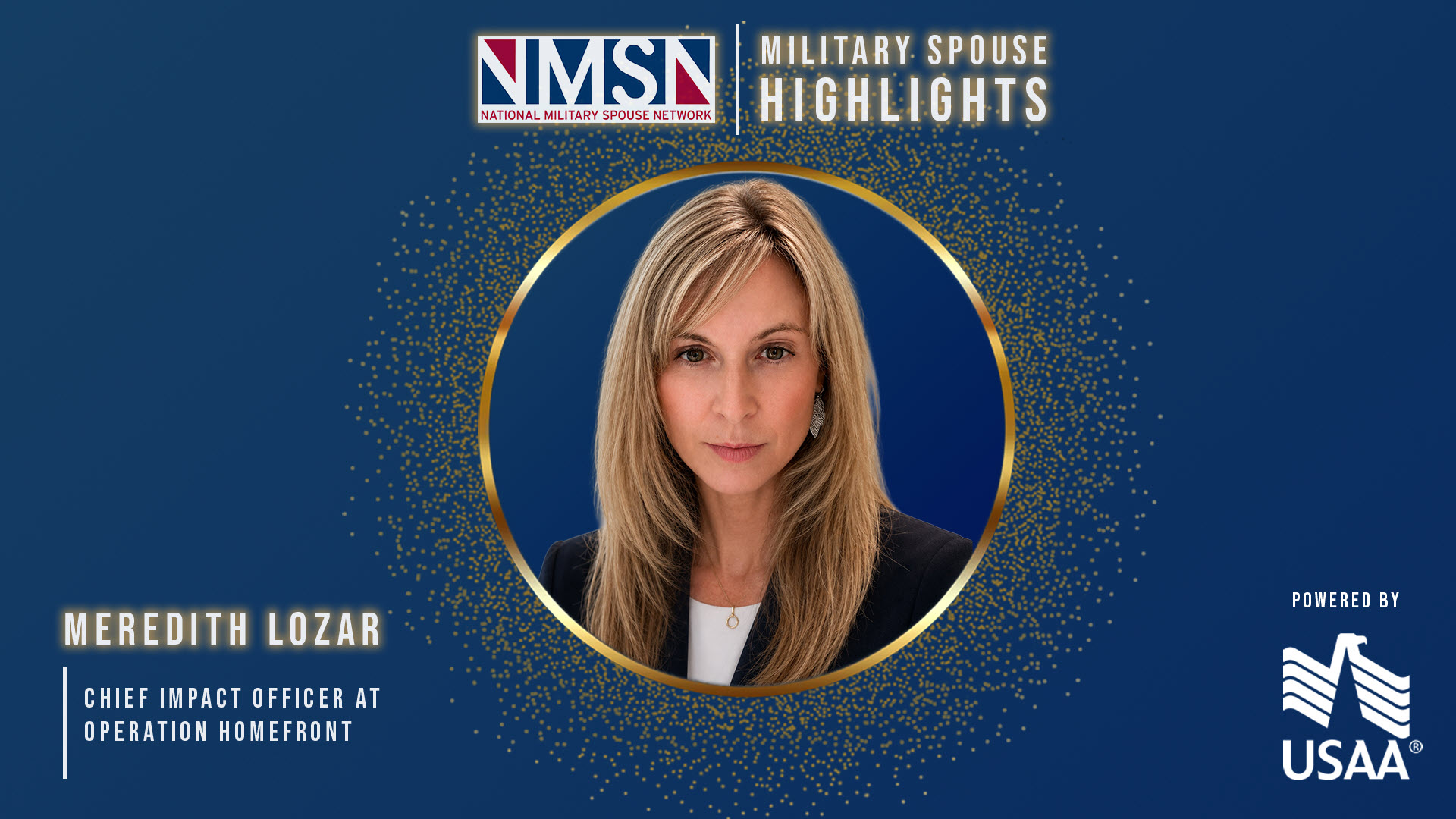

Meredith Lozar
Chief Impact Officer at Operation Homefront
Service Member's Branch - Marine Corps
Service Member's Status - Currently Serving - 25 years
 |
What has been your military spouse career/entrepreneur journey so far?
My career began in direct service, education, and financial readiness before expanding into national program leadership, partnerships, workforce development, and organizational strategy. While stationed in Okinawa, I worked with the Air Force Education Department through the University of Oklahoma's Pacific Theater programs. During a later assignment at Fort Leavenworth, I developed a financial readiness program for incarcerated service members preparing to return to their communities. From there, my career grew through roles with organizations including Navy-Marine Corps Relief Society, National Military Family Association, Blue Star Families, JPMorgan Chase, Hiring Our Heroes, and now Operation Homefront. Each move added a different layer to my experience, ultimately taking me from direct service delivery to executive leadership and national systems-level work.
Tell us about yourself.
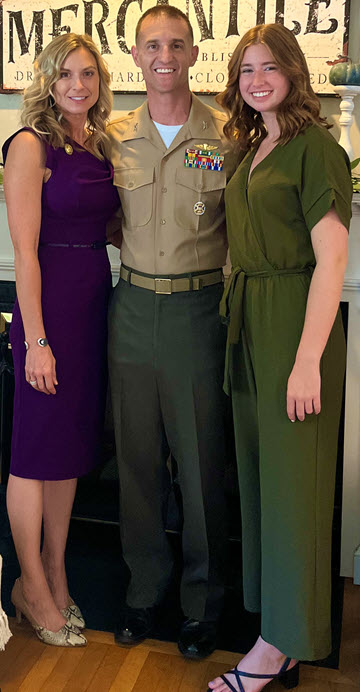
My name is Meredith Lozar, and I am a military child, an active-duty Marine Corps spouse, and the Chief Impact Officer at Operation Homefront. Over more than two decades of military life and 14 duty stations, I have built a career across the nonprofit, corporate, and government sectors focused on military and veteran families, workforce development, financial readiness, and strategic impact. I live in Georgia with my husband, Nick, and our daughter, Clara. Outside of work, I enjoy staying active, reading, traveling, and spending time with my family.
Tell us about a "typical" day in your professional life.
There is rarely a truly typical day, but most begin with reviewing organizational priorities, preparing for leadership meetings, and identifying decisions that need to move forward. As Chief Impact Officer, I spend much of my time connecting strategy, programs, partnerships, data, and evidence so that we can better understand and strengthen the impact we have on military and veteran families. My day may include working with program leaders, reviewing evaluation findings, meeting with corporate or nonprofit partners, coaching members of my team, and translating complex information into clear recommendations for senior leaders. I also try to reserve time for relationship-building because much of my work depends on bringing people and organizations together around a shared goal. In addition, as a regimental CO's spouse, my day includes pro-bono work for the USMC and the families we support in our unit and community.
If you've been stationed overseas, how did this affect your career and or business?
We were stationed in Okinawa, Japan, for three years. Overseas employment can be challenging because the number and type of available positions are limited, but the assignment also created an opportunity for me to return to my Air Force roots. I worked alongside the Air Force Education Department through the University of Oklahoma's Pacific Theater programs, helping support service members pursuing higher education. That experience reinforced the importance of flexibility, networking across military branches, and being willing to identify opportunities that may not look exactly like the next step you originally envisioned.
What has been your biggest military spouse career struggle and how did you overcome it?
My greatest challenge has been maintaining career continuity and forward momentum through 14 duty stations. Every move required rebuilding networks, navigating different job markets, and sometimes convincing employers that I could offer long-term value despite the uncertainty of military life. I overcame that by treating my career as a growing portfolio rather than a single, perfectly linear path. I invested in education and credentials, maintained relationships across moves, sought roles that built transferable skills, and became comfortable pivoting between sectors without losing sight of the larger purpose behind my work.
What role did mentors and sponsors play in your journey?
Mentors and sponsors have been essential to my career. Mentors helped me think through choices, recognize my strengths, and navigate transitions, while sponsors advocated for me, opened doors, and helped me maintain employment and earn promotions across duty stations and sectors. In recent years, I have intentionally sought mentors outside the military and veteran space because they challenge my assumptions, stretch my thinking, and help me see my abilities and possibilities through different lenses. Their perspective has often helped me recognize opportunities before I was fully ready to see them for myself.
How does your career path differ from what you imagined for yourself?
I once imagined having a more traditional, linear career tied to a particular employer, profession, or geographic area. Instead, military life led me through education, financial counseling, nonprofit leadership, corporate work, workforce development, partnerships, and organizational strategy. The path has been far less predictable than I anticipated, but it has also been more meaningful and expansive. What initially felt like a series of disruptions ultimately became one of my greatest professional strengths because I learned to connect ideas, people, and sectors that often operate separately.

How did military life (PCSing, deployments, trainings, etc) factor into your career decisions?
Military life factored into nearly every major career decision I made. PCS moves affected which jobs were available, deployments and field exercises influenced how much flexibility our family needed, and some assignments required me to accept a lateral move, change sectors, or create an opportunity where one did not already exist. At times, I made choices based on what our family needed rather than what appeared to be the most direct professional advancement. Those decisions were not always easy, but they strengthened my adaptability, leadership, and understanding of the real barriers military families face.
Have you ever had to geo-bach due to your career/entrepreneurship?
Yes. My husband and I geo-bached for approximately six months while he attended Command and General Staff College at Fort Leavenworth as one of 25 Marines selected for the school. It was an especially difficult period because we were also coming off multiple Afghanistan deployments and demanding field operations while raising a young child. I eventually decided to leave my job and join him, and I used that transition to start a financial readiness program at the Joint Regional Correctional Facility and the U.S. Disciplinary Barracks, teaching service members who were within 18 months of returning to society. My advice is to make geo-baching a deliberate, time-limited family decision rather than simply allowing it to become the default. Be honest about the financial, emotional, childcare, and career costs; agree on communication routines and decision points; build support systems in both locations; and regularly reassess whether the arrangement is still serving the family. A decision that looks best professionally may not remain the best decision when the full cost to the family is considered.
What resources have you found to be useful in your career/entrepreneur journey?
The most valuable resources have been mentors, sponsors, professional associations, alumni networks, military spouse organizations, and strong relationships maintained across duty stations. Education and professional credentials also helped me demonstrate continuity and expertise when my résumé reflected frequent geographic moves. Organizations such as Hiring Our Heroes, National Military Family Association, and professional communities like the Association for Financial Counseling and Planning Education can provide employment resources, training, networking, and a sense of professional belonging. I have also found LinkedIn and intentional relationship-building to be invaluable—not simply when I needed a job, but as an ongoing way to learn, contribute, and remain connected to people across sectors.
Final word: what are your top tips for other military spouses about navigating a career within the military lifestyle?
My top advice is: do not give up on your end goal. Be willing to remain flexible about how you get there, but do not assume military life means you have to abandon the career you want. Your path may include pauses, lateral moves, sector changes, remote work, additional education, or opportunities you never expected—but those experiences can strengthen your career rather than diminish it. Build and maintain your network before you need it, seek mentors and sponsors, and learn to clearly communicate the value that adaptability brings to an employer.
For spouses navigating military retirement or transition, remember that leaving active-duty life creates both opportunity and uncertainty. Talk early and honestly as a family about location, finances, caregiving responsibilities, and whose career needs to take priority during different phases. After years of shaping decisions around military requirements, this transition can be a chance to make more intentional choices about where and how you want to work. Stay focused on the end state, remain open to a journey that may look different than expected, and trust that you never know where that flexibility may ultimately take you.
| Listen to an interview with Meredith to hear more about her story. |
Tell Us YOUR Story |
Meet Spouses from Previous Weeks:
























"The stories, experiences, and perspectives shared in these Military Spouse Highlights are provided by the individual contributors and reflect their personal views. While the National Military Spouse Network (NMSN) is honored to share and celebrate these voices, the content does not necessarily represent the views or endorsements of NMSN."