
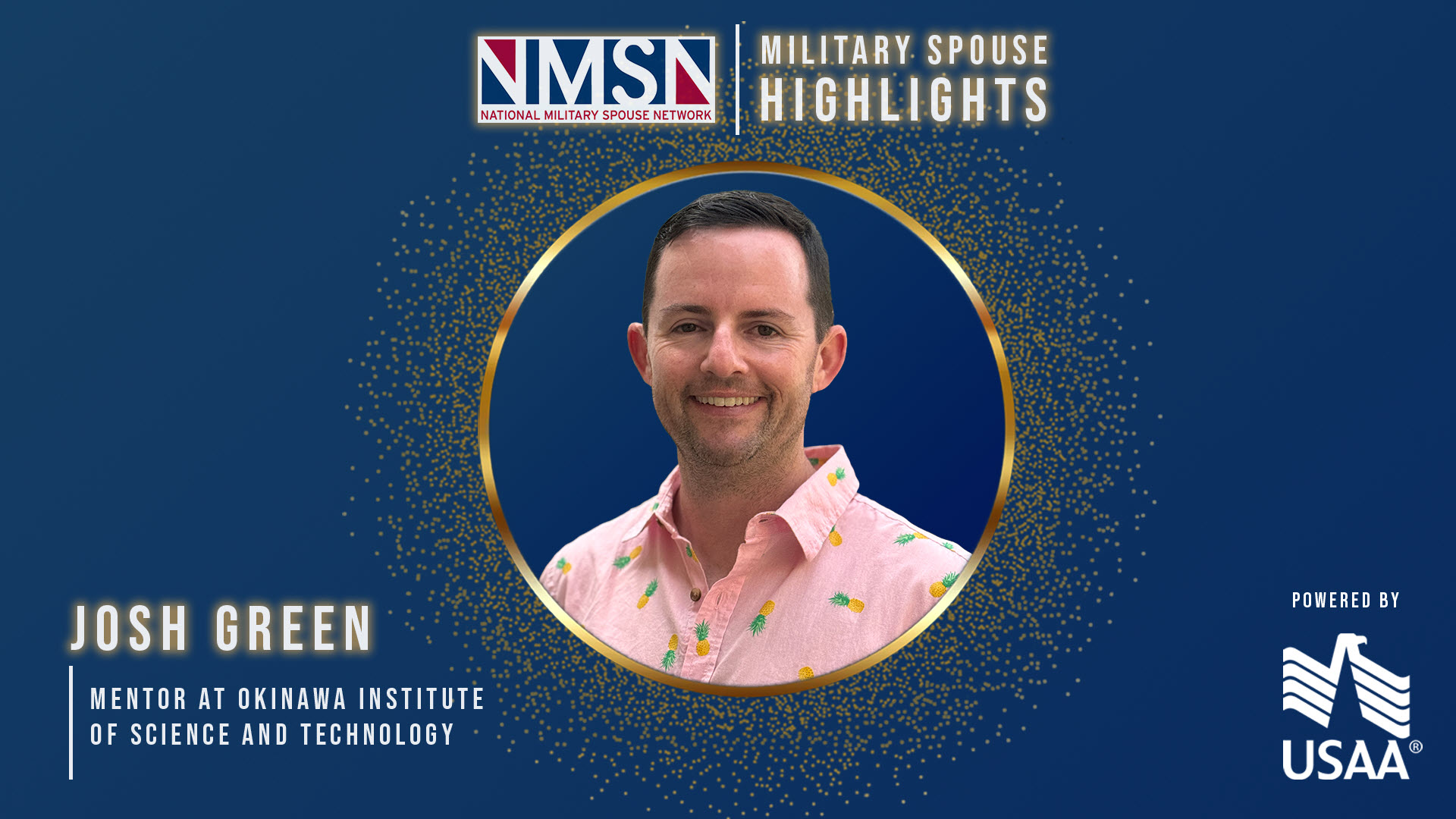
Josh Green
Mentor at Okinawa Institute of Science and Technology
Service Member's Branch - Navy
Service Member's Status - Currently Serving - 15 years
 |
 |
 |
What has been your military spouse career/entrepreneur journey so far?
My wife and I married in 2016 as I finished my MBA and worked at the Nevada Small Business Development Center (SBDC). I immediately moved to Yokosuka, Japan, where she was stationed, and began working for two tech startups—one providing environmentally-safe hydraulic fluid and the other developing a next-generation unmanned system. During my time in Yokosuka, I volunteered for the USO, Red Cross, Oakleaf Club, and also helped to found an organization to support military spouses with their careers. In 2017, we moved to Fort Belvoir, VA. During the four years we were there, I began to work for the Virginia SBDC at George Mason University. I helped build a new program to support early-stage tech startups with the program's director, who is a Navy veteran. After two years, he departed and I became the new director. Also during that time, I joined the Military Officers Association of America's Currently Service Spouse Advisory Council, which I found to be an incredible opportunity. In 2019, I became that year's AFI Military Spouse of the Year for Fort Belvoir, which was also an incredible opportunity to connect with some amazing spouses from around the world. We moved to Naples, Italy, in 2021 and I was grateful to keep my job—mainly facilitated by the shift to remote work during COVID. I kept that same role when moving to Chicago in 2023. My wife deployed during that time and was also selected for a role in Okinawa. So, I executed the entire move while she was away, as many do. Knowing that the time zone would not be friendly, I decided to leave my job with the SBDC. My old boss, who had moved to George Washington University, connected me with the Okinawa Institute of Science and Technology's (OIST) Innovation office. I pitched them an idea to support their researchers and students, which they liked, and was hired to run several different programs. We moved in Okinawa in 2025 and I have been working at OIST since then. I am now volunteering for my wife's unit on-island.
Tell us about yourself.
My name is Josh and I am from Reno, Nevada. I grew up in two family-owned businesses, which motivated me to work with new and growing organizations in my career. I have been married to my wife, who serves in the US Navy, for 10 years. When I have free time, I enjoy reading, writing, watching movies, surfing, hiking, cooking, and traveling.

Tell us about a "typical" day in your professional life.
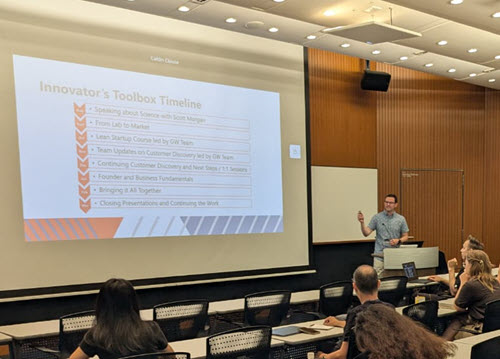
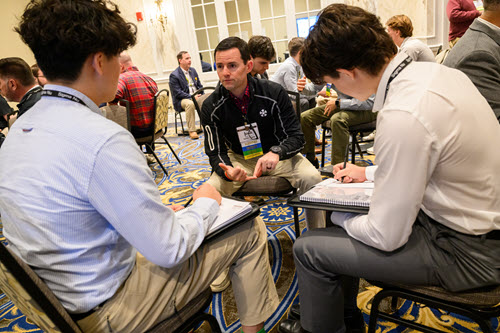
I am incredibly grateful that I was able to secure a job while my wife is currently stationed in Okinawa, Japan. I support three different programs at the Okinawa Institute of Science and Technology—a postgraduate international university. I would say that I do not ever have a typical day as there is a lot of variation in what I focus on, but I do have a number of typical activities. I develop and facilitate programming to teach researchers and PhD students about technology commercialization and what they need to know about the process. I also work one-on-one with students and researchers to develop action plans for their projects.
If you've been stationed overseas, how did this affect your career and or business?
We have been stationed overseas three times so far. The first time, I took two jobs with two different tech startups. That was specifically done to allow me some flexibility. I did have to give up other opportunities that would not allow for remote work at the time. For our second time, I was able to keep my job, which was fantastic. During our third and current time overseas, I was able to secure a role at a local university, which I was and am grateful for.
What has been your biggest military spouse career struggle and how did you overcome it?
The biggest struggle was finding meaningful employment while moving regularly. I am grateful that I was able to do that through a mixture of leaning on my network, schooling, experience, good timing, and persistence.
What role did mentors and sponsors play in your journey?
I have had some amazing mentors and sponsors during my journey. Without them, I would not have had any of the opportunities that came my way. They helped me navigate the processes, connected me with their network, offered my jobs, and encouraged me throughout my career.
How does your career path differ from what you imagined for yourself?
I believe that my career would have followed a similar path, but it has included different locations than I expected.
How did military life (PCSing, deployments, trainings, etc) factor into your career decisions?
My first choices after finishing my MBA were specifically selected due to a PCS. My last two roles were based on where we were stationed at that time. The first allowed me to keep the role through two PCS moves and the second will likely last just during our time in Okinawa.
Have you ever had to geo-bach due to your career/entrepreneurship?
I geo-bached during the last year of my MBA program. It was tough, but my advice would be to find the communication format(s) and tempo that work for both of you—based on what is available. That allowed us to get through it as well as can be.
What resources have you found to be useful in your career/entrepreneur journey?
Syracuse University's IVMF is an excellent resource and is how I prepared for my PMP certification. Hiring Our Heroes Military Spouse Fellowship was also great - even though COVID derailed the outcome for me. MilitaryOneSource has also really helped with information. MOAA is an excellent advocacy group. American Corporate Partnership provided me a mentor, which was awesome. I believe those are the top ones for me.
Final word: what are your top tips for other military spouses about navigating a career within the military lifestyle?
I believe understanding your own goals is the first step. From there, it is about identifying what you need to achieve those goals. Not all careers lend themselves to the regular moves and military lifestyle, but there are rewarding opportunities. Talking to others in your field, other military spouses, and finding mentors is important to get different perspectives. And, tell everyone you meet about your goals and what you are trying to do. Someone will inevitably have a connection for you.
| Listen to an interview with Josh to hear more about her story. |
Tell Us YOUR Story |
Meet Spouses from Previous Weeks:






"The stories, experiences, and perspectives shared in these Military Spouse Highlights are provided by the individual contributors and reflect their personal views. While the National Military Spouse Network (NMSN) is honored to share and celebrate these voices, the content does not necessarily represent the views or endorsements of NMSN."