
Why the Rise of Returning Professional Internships is Significant for Military Spouses
by Carol Fishman Cohen, iRelaunch co-founder and CEO
In mid-March, my local TEDxBeaconStreet talk "How to get back to work after a career break" got elevated to the big TED platform. Since then it has been viewed almost 1.2 million times and translated into 21 languages.
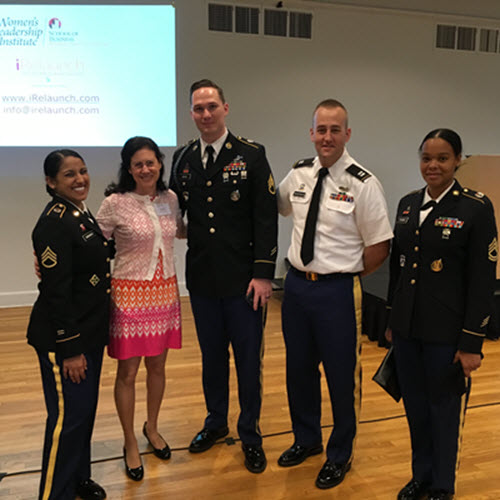
My TED talk focuses on career reentry and returning professional internships. All TED talks are supposed to discuss a “Big Idea.” The “Big Idea” I put forth is that if employers can successfully use internships as a vehicle to engage with the population of professionals returning from career break, they could then use internships to engage with a whole range of non-traditional career transitioners; veterans transitioning to civilian roles, military spouses transitioning to permanent work after their spouse concludes active duty, retirees coming out of retirement, and ex-pats repatriating in their home country.
The concept rests on the theory that some employers attach risk to hiring non-traditional career transitioners. The internship reduces the perceived risk because it allows the employer to base the hiring decision on an actual work sample instead of a series of interviews, and the employer does not have to make the permanent hiring decision until the internship period is over. One company has already launched a veterans return to work program based on their reentry internship program, and another company broadened the candidate pool for their reentry internship program to include veterans and other career transitioners.
The returning professional internships are paid and they are open to men as well as women. Typically, the reentry interns begin on the same day as a cohort. Depending on the company, the internship can be as short as 6 weeks or as long as 9 months. Hundreds of people apply for about 25 spots in a typical cohort, although companies piloting the concept may start with a smaller sized group. At the end of the internship, an intern can “convert” to a permanent employee or the intern may not get a permanent offer. Even if an offer is not received, these rich professional development experiences are excellent resume and interview material.
With “conversion rates” - the number of interns who “convert” to permanent employees – running consistently above 50%, increasingly, the reentry internship model is making economic sense for employers as well as allowing them to engage with new and impressive pools of return-to-work talent.
A group of engineering-companies are all piloting mid-career internship programs for returning technical professionals in 2016 through the STEM Reentry Task Force initiative with the Society of Women Engineers and iRelaunch. More information about them is here. In addition, a number of financial services firms have active programs; Credit Suisse, Goldman Sachs, JP Morgan, MetLife, Morgan Stanley and UBS. AT Kearney is running a program in consulting. The OnRamp Fellowship has programs running in law firms and the legal departments of a number of companies. And Path Forward has run reentry internships in Colorado and is now expanding their program.
While your spouse is still on active military duty and you are moving around, use the time to determine what kind of work you will want to return to once his or her active duty has concluded and identify any courses, certification or other skills updating you will need. Try to take online courses or in-person courses wherever you are stationed so you can be well prepared to take advantage of one of these internship programs if they match with your professional specialty. If not, then as I suggest in the TED talk, suggest to a potential employer that does not have a formal career reentry program the idea of engaging with you on a short term, non-binding basis. An internship-like arrangement does not need to be called an “internship.” It can be a contract role, special project, temp-job, or maternity coverage. Please share your story with us at iRelaunch when you successfully relaunch your career. We want to add to the number of military spouse success stories we have on record. (Click here and check “Military Spouse” under “Strategy” and you will find them.) And while you are in the process of relaunching, make sure you consult our tools and resources on iRelaunch.com, and sign up for our mailing list here to be the first to know when reentry internship program applications open, employers are posting jobs for relaunchers, and career reentry events are happening.
Carol Fishman Cohen, CEO of iRelaunch, consults to some of the world's largest corporations on career reentry strategy and programming. Her seminal Harvard Business Review article "The 40 Year Old Intern" focuses on the use of the internship as a vehicle for employers to engage with experienced professionals returning from career break. It was selected an "HBR article that changed the way I think" as part of HBR's 90th anniversary recognition of HBR articles that made the biggest difference in readers' and contributors' lives. Her TED talk "How to get back to work after a career break" received over one million views within two months of its posting and has been translated into 21 languages to date. Carol's return to work at Bain Capital after 11 years out of the full-time workforce is documented in a Harvard Business School case study. She is the mother of 4 Millennials and lives in Boston with her husband Stephen.
Have a question about your career track for Carol? Ask here your question/answer may be printed in a future issue.